The amount that actually binds.
Why a contract states the sum twice, which of the two versions wins, and how to phrase the one that does.
numerosaletras team · Updated August 31, 2026 · 10 min read
What you will learn
- ▸Why the sum appears twice and which version prevails.
- ▸The standard phrasing for a payment clause.
- ▸Where invoices differ from contracts.
- ▸How to name a currency the reader might not assume.
- ▸The five errors that create a dispute.
01 · the rule
The words are the amount.
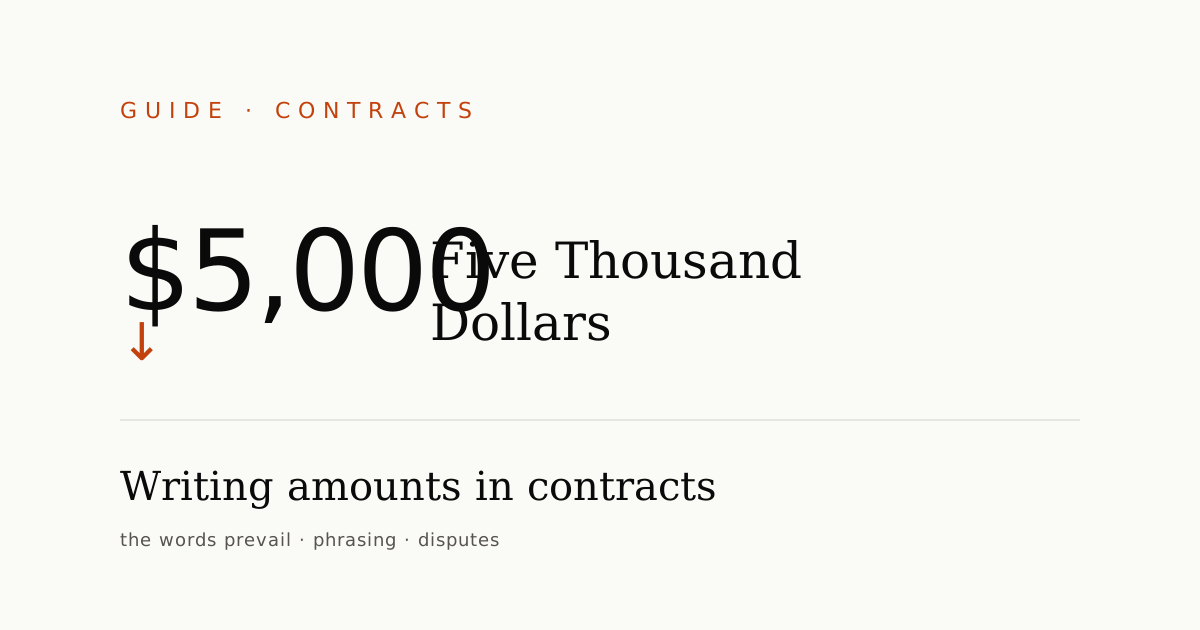
When a document states a sum in words and in figures and the two disagree, the written words control.
That rule is old, near-universal in common-law jurisdictions, and it has a consequence most people never think about: the field they fill in carefully — the box with the digits — is the one that matters least, and the long line they scrawl is the one that binds.
Reversing that habit costs nothing and removes an entire category of dispute. Everything else in this article follows from it.
02 · why twice
A cross-check, not a ceremony.
Figures are easy to alter. A 1 becomes a 4 with one stroke, a 3 becomes an 8, and a zero can be added to the end of a number without disturbing anything around it. None of those attacks works on a phrase: turning "Fifty Thousand" into "Five Hundred Thousand" means forging two whole words in someone else's hand, in a space that has no room for them.
Stating the amount twice therefore does something a single statement cannot. An alteration to either version contradicts the other, and a contradiction is visible where a clean forgery is not. The rule that the words prevail is what gives that cross-check its teeth — without it, an altered figure would simply create ambiguity.
The most common failure has nothing to do with fraud. An amount gets renegotiated late, the figure is updated, and the words are left as they were. The document now says two things, and the one that governs is the stale one.
That failure has a shape worth recognising, because it is predictable. It happens on the documents that go through the most revision, which are also the ones with the most at stake; it happens near the end, when everyone is tired of the file; and it survives review because both versions look correct in isolation. Nobody reads a payment clause twice — once for the figure and once for the words — unless they have been caught before.
The habit that prevents it is small: whenever an amount changes, change both statements in the same edit, and read the clause once more before it goes out. On a document that has been through several rounds, converting the words back to a figure and comparing takes seconds and catches exactly this.
03 · the phrasing
Five forms, and where each belongs.
The wording differs by document, and using the wrong form is the tell of something drafted in a hurry.
| Document | Form | Why |
|---|---|---|
| Contract, standard | the sum of Fifty Thousand Dollars ($50,000.00) | Words first, figures in parentheses. The commonest form in American practice. |
| Contract, emphatic | the sum of FIFTY THOUSAND DOLLARS ($50,000.00) | Capitals to make the amount stand out from the clause around it. Common in older drafting. |
| Invoice total | Total: $50,000.00 — fifty thousand dollars | Figures lead on an invoice, because that is what a reader is scanning for. |
| Check amount line | Fifty Thousand and 00/100 | No currency word, cents as a fraction. Only on a check. |
| Promissory note | promises to pay Fifty Thousand Dollars ($50,000.00) | The written words are the operative amount of the instrument. |
The check line is the one that surprises people, because it drops the currency word entirely — it is already printed on the row — and writes the cents as a fraction over one hundred. That format belongs on a check and essentially nowhere else. The converter on this site produces both it and the sentence form, so the two do not get mixed up.
04 · across borders
Two conventions, one string.
€50.000,00 is fifty thousand euros in most of Europe and fifty euros read with English conventions. The characters are identical and the amounts differ by a factor of a thousand, with nothing in the string to say which is meant.
Cross-border agreements are exactly where the two meet, and neither side is doing anything wrong. The document has to pick one — in an English-language contract, the point for decimals and the comma for thousands — and then the amount in words settles it beyond argument, because "fifty thousand euros" reads the same under every convention there is.
The same goes for the currency itself. Several countries use the dollar; naming it in the binding version — "Fifty Thousand Canadian Dollars" — costs one word and closes the question.
05 · mistakes
Five that create a dispute.
— Words and figures that do not match
+ Check them against each other before signing
The single most expensive error in this whole subject. It usually happens when a figure is updated late in a negotiation and the words are not.
— ($50,000)
+ ($50,000.00)
Write both cent digits even on a round amount. An amount with no decimals invites a reader to wonder whether something was cut off.
— Fifty Thousand Dollars ($50,000.00) USD
+ Fifty Thousand US Dollars ($50,000.00)
The currency belongs in one place, not two. Repeating it after the figure reads as a patch on an earlier ambiguity.
— the sum of fifty thousand dollars
+ the sum of Fifty Thousand Dollars ($50,000.00)
Words alone lose the cross-check that the double statement exists to provide. If only one form is present, there is nothing to disagree.
— €50.000,00 in an English-language contract
+ €50,000.00
The decimal comma is standard in much of Europe and wrong inside an English document. On a cross-border agreement this one is worth an explicit look.
06 · questions
Frequently asked questions.
-
Q01
Why is the amount written twice in a contract?
To create a cross-check. Figures can be altered with a single stroke — a 1 into a 4, a zero appended to the end — and words cannot. Stating the amount both ways means an alteration to one version contradicts the other, which is exactly what makes tampering visible.
-
Q02
Which version wins if the words and the figures disagree?
The words. It is a long-standing rule for negotiable instruments and it carries over into general contract interpretation. The practical consequence is that the long line most people scrawl is the binding one, and the box of digits they fill in carefully is the summary.
-
Q03
How should I phrase the amount in a payment clause?
The standard American form puts the words first with the figures in parentheses: "the sum of Fifty Thousand Dollars ($50,000.00)". Capitalisation varies by firm — Title Case and full capitals are both common — and consistency within the document matters more than which you choose.
-
Q04
Do invoices need the amount in words?
Not usually. Invoices are scanned for the figure, and most jurisdictions require nothing more. Higher-value invoices sometimes repeat the total in words for the same reason contracts do, and it costs nothing to add where the sum is large enough to be worth altering.
-
Q05
Should the amount be in capitals?
It is a drafting convention rather than a requirement. Capitals make the amount jump out of a dense clause, which is the point, and some firms capitalise defined terms and amounts as a house rule. What is not defensible is capitalising the amount in one clause and not the next.
-
Q06
How do I write an amount in a currency the reader may not assume?
Name it in the words rather than bolting a code onto the figure: "Fifty Thousand Canadian Dollars (CAD 50,000.00)". Several countries use the dollar and the euro area spans twenty currencies' worth of local convention, so on anything crossing a border the currency belongs in the binding version.
-
Q07
What happens if the amount is wrong after signing?
That is a question for a lawyer and it depends on what happened. What is worth knowing beforehand is that "the figures say something else" is a weak position when the words are unambiguous — which is the whole reason to read the words before signing rather than after.
-
Q08
Is a scanned or emailed contract treated the same way?
For this purpose, yes — the rule is about the words on the document, not the medium. What changes with an electronic file is the threat: nobody alters a PDF with a pen, but versions get confused, and a party can end up signing a draft that is not the one negotiated. The cross-check between words and figures still catches the mismatch.
-
Q09
Should the amount also appear in a schedule or annex?
If it does, it has to match, and that is a third place for the same number to drift. Some drafters deliberately state the amount once in the operative clause and refer to it elsewhere rather than repeating it, which removes the possibility of disagreement at the cost of a slightly heavier sentence.
-
Q10
Does this apply outside the United States?
The double statement and the primacy of the words are near-universal in common-law jurisdictions and widespread elsewhere. The phrasing differs — a British contract reads differently from an American one, and civil-law notarial deeds have their own formulas — but the underlying reason is the same everywhere.
Read the words before you sign.
They are the version that governs, and checking them takes a few seconds. Running them back through a converter is the fastest way to confirm the two halves of the document agree.